
The "Protestant" Problem
Why the Appellation Falls Short

The Problem with “Protestants”
Lutherans like myself tend to bristle when we’re called “Protestants.” I think there are a couple main reasons. First, the appellation “Protestant” doesn’t do much work to define anything positively. Being a Protestant only means you’re a Western Christian who’s not Roman Catholic. That’s the one trait that all Protestants have in common. But if you say you’re a Protestant, although I know you’re not a Roman Catholic, I still don’t know what you are. You could be a Baptist, a Methodist, a Lutheran, a Presbyterian, a Pentecostal, non-denominational, or a host of other things, many of which are wildly different from one another.
I think the other reason Lutherans often bristle at the term “Protestant” is because it tends to be associated especially with non-liturgical, non-sacramental traditions. After all, if the Roman Catholics have liturgy and sacraments, and we’re not Roman Catholic, then we’re not going to have liturgy and sacraments. But, since Lutherans do have a robust liturgical and sacramental tradition, lumping us together with all the other “Protestants” can really give the wrong impression. In fact, I’ve encountered the effects of that wrong impression in real life. I had a Roman Catholic friend in high school who was shocked to learn that Lutherans believe the bread and wine of the Lord’s Supper is the true body and blood of Jesus. My friend simply thought that all Protestants are the same, united by opposition to all things Roman Catholic.
But there’s still another reason why “Protestant” is a problematic term—this one a historical reason. I was reminded of this in a friendly discussion with the local Roman Catholic priest the other day. I made a comment about the SSPX, and he responded that they’re Protestants, just like us Lutherans. We were having a light-hearted discussion, but it nevertheless revealed that he considers the essence of “Protestantism” to be “protest,” and specifically “protest against the authority of the pope.” In his mind, the SSPX, confessional Lutherans, and a host of other non-Roman-Catholic groups are rightly lumped together as “Protestants,” because the one thing they all have in common is their protest against papal authority. The defining characteristic of all Protestantism, in his mind, is a rebellious spirit of protest.
On its face, that idea seems to make a lot of sense. The only problem is that it doesn’t have much to do with the historical origins of the term “Protestant.” Here’s an explanation from the Historical Dictionary of Lutheranism:
The Diet of Speyer in 1526 had decided that each territory in the German empire was free to decide about its religious allegiance according to the decision of its ruler. But three years later the Diet of Speyer in 1529 rescinded with a majority vote of the papal party the unanimous action of 1526. Against this vote, six evangelical princes and 14 imperial cities used the legal means of protestatio in order to object to the decision of the majority. Since then, others frequently called them the protesting estates or the protesting ones. Their own designation in the 16th century was not “protestant” but evangelical or “those related in religion” or “adherents of the Augsburg Confession.” Only after 1700 was the term “protestant” used as self-designation; and decades later the term “Protestantism” followed suit. A legal term had become a confessional one.1
As this quotation shows, the term “Protestant” arose out of a specific situation, and at the time, it made perfect sense as a descriptive term for those who had filed a formal, legal protest against the decision of the 1529 Diet of Speyer. However, it is ill-suited to describe the theological views of those who filed the original protest—not to mention many others who bear little to no theological or legal relation to them. Yet, unfortunately, that’s precisely what the term is now asked to do in common parlance.
Perhaps the most unfortunate aspect of all this is that, as my conversation with the RC priest demonstrates, the essential characteristic of “Protestantism” is often thought to be a radical spirit of rebellion and protest. But that is simply not the case—at least it certainly wasn’t for the original “Protestants.” A glance at the 1529 protestatio shows that those who submitted this legal filing certainly could not be accused of fostering a rebellious spirit. Here are a couple paragraphs:2
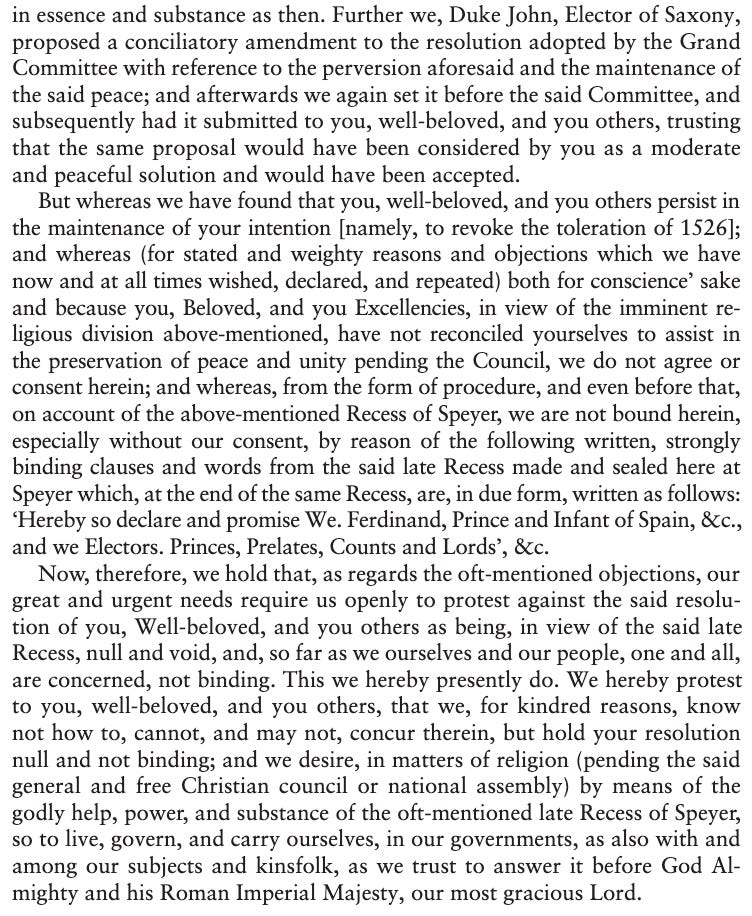
Those are not the words of men animated by a rebellious spirit! These were temperate men seeking a legal, measured, peaceful solution to a highly volatile religio-political situation. True, they were prepared to stand their ground, and were not willing to violate their consciences for the sake of feigned unity. But that hardly makes them “rebels” or even “protestors.” Their “protest” consisted of using the legal means available to them to calmly and respectfully register their objection to the Diet’s ruling. That hardly makes them “protestors” in the way we think of a mob animated by a spirit of anarchy and rebellion!
Imagine a Supreme Court justice who registers an official dissent from the majority ruling on some case. Would it be accurate to characterize such a justice as a “protesting rebel” on that basis? Now, imagine that their dissent pointed out that the majority ruling was in fact reversing a unanimous ruling of the court from three years prior, and such a characterization is even more absurd. Take it still another step, and imagine that the author of the dissent said that his opinion was only intended to be temporary, pending an anticipated formal review and reconsideration. Well, that’s the substance of the “protest” that these “Protestants” filed in 1529. The Lutheran princes and confessors were not animated by a spirit of rebellion or protest, but conscientious fidelity to the word of God—a fidelity that was formally presented in deeply respectful terms to those who held governing authority.
Günther Gassmann, with Duane H. Larson and Mark W. Oldenburg, Historical Dictionary of Lutheranism (Lanham, MD: The Scarecrow Press, Inc., 2001), 278.
The text is from B.J. Kidd, ed., Documents Illustrative of the Continental Reformation (Oxford: Clarendon, 1911), 244, and can be found at this link.
This is great! And personally, the timing of this could not be better as I was just in a discussion with a Roman friend about how I cringe when I’m labeled “Protestant” as a confessional Lutheran. Thank you for this!
This brought me back to my high school and college days, especially regarding The Lords Supper., also had some “deep” discussions about the Trinity and making the sign of the cross.
Thank you for waking up my brain